
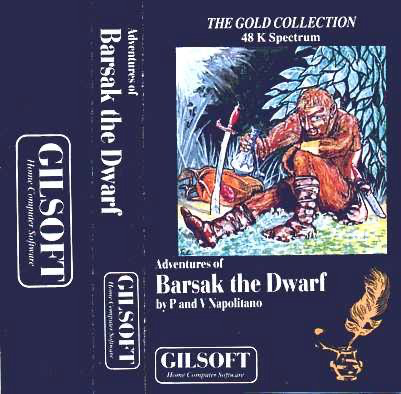
We’ve arrived at the first Gilsoft released game in our alphabetical adventures with The Adventures of Barsak the Dwarf. Anybody familiar with the adventure writing system The Quill will recognise the style and format here immediately. It’s a standard text adventure with the tried and tested parser mechanics and vocabulary. This game (subtitled The Early Days suggesting there is more to come from Barsak) was written by P and V Napolitano, published by Gilsoft as part of their Gold Collection, and released on the Commodore 64 and ZX Spectrum in 1984.
The Quill system is a complicated one and can make for some very complex stories with well described and detailed locations. Barsak wasn’t one of those. The location descriptions were sacrificed to make the game seem large with around 120 locations, but with only so much memory to accommodate the adventure, descriptions were kept to a minimum. It is described elsewhere as “more a series of death-traps to overcome by utilising the right object at the right time than a series of puzzles to be solved”.
It’s a game that suffers too much from sheer frustration, which many of these games from the early days of text adventures do. Puzzles that expect something that the user couldn’t possibly know about, dying from lack of food or water after a strict number of moves, making exploration challenging if not near impossible. It isn’t that Barsak isn’t solvable, but it is designed to be started again and again after dying many times and learning from those deaths. The best games, I feel, did not do this, with the emphasis in later 80s adventures being on fun rather than difficulty. However, like all Quill games, there is a SAVE function and anybody that has read one of my earlier adventure game reviews will know that SAVE OFTEN is a mantra I swear by. Barsak is no exception.
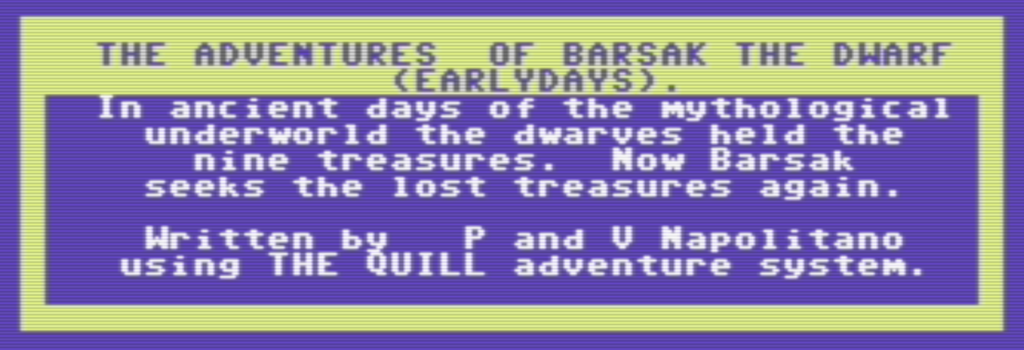
There isn’t much information on the (presumably) Napolitano siblings, and I can not find any information about a follow up game or indeed any other game written by them after Barsak.
The aim of the game is to collect all nine treasures and be carrying, or wearing them, at the end to complete the adventure. You start off in a road in a forest and you really need your imagination to paint the scene. The locations are barely more than a couple of sentences, but exits are shown which makes map drawing much easier. You will need this map, because a few wrong turns or too many tries will result in, yep, your death. The issue here is you’re not entirely sure without multiple tries how far wrong you’ve gone or even if the situation is recoverable, so utilising the SAVE function is perhaps of little use early on, and trial and error may be the better strategy. It isn’t very long before the messages start to appear that you are hungry and dwarves, bless them, obviously have a very low tolerance for hunger.
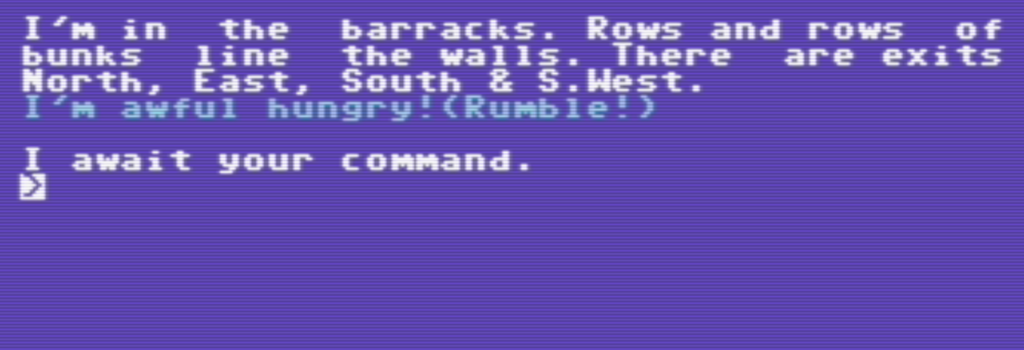
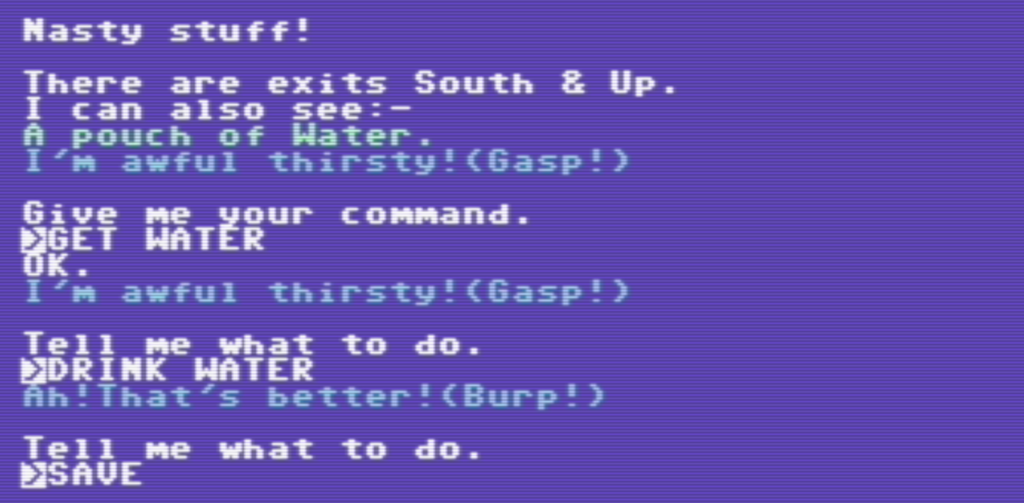
Food can be found relatively early on, although even then you can’t waste turns by LOOKING or trying to EXAMINE anything, but water is more difficult to find. I played through quite quickly the first time and didn’t read all room descriptions. That’s not surprising as most descriptions are so boring you kind of gloss over them, so I missed the clue for the first puzzle which is vital to get some water to prevent you from dying of thirst.
So, by trial and error and diligent map making, as well as tuning into the clues in one particular room, we end up fed and watered and no longer in mortal danger. We can now concentrate on finding the treasures!
Just because hunger and thirst are no longer the grim reapers following us around the map, it doesn’t mean we can’t die arbitrarily and often. Just walking into a room can do this, as can using the wrong word to utilise one of the objects you’re carrying. I ended up with about 18 save files over the course of the game and it was just becoming so tedious.
From here we’re basically exploring and collecting items. It’s easy to forget what you are carrying at times so don’t forget to check the inventory now and then which will likely jog the memory and give you some clues, but also there is the usual annoying carrying limit (oh thank you D&D for magic pockets!) so you’ll need to be careful with picking up and dropping stuff. This part of the game is map heavy and it will be vital to keep a track and make sure you’re not straying too far. Also, you’ll need to drop some items to allow you to pick others up, going back to retrieve them again when needed. Mark these on your map! I’d suggest once you pick an item up that you save the game. Saving often really helps, and naming the save files correctly is also very important so you don’t overwrite previous ones!
So, lots of wandering around and picking up items and yes, the frustration continues. I’m all for working out puzzles and trial and error of course, but (slight spoiler) who would think to drop a teddy bear near a zombie would prevent death and provide a piece of treasure? It’s guess trying everything until you find the right move is part of the reward.
Another annoyance. There are various situations where you need to kill an an enemy, at least ones that aren’t pacified by teddy bears that is, and to do so you just have to guess what word and what item to use. You can try HIT, USE, STAB, SMASH, THROW, WAVE with the axe, foil and other times and it’s literally just pot luck as to what works and what doesn’t. Again (need I say it) saving is your friend!
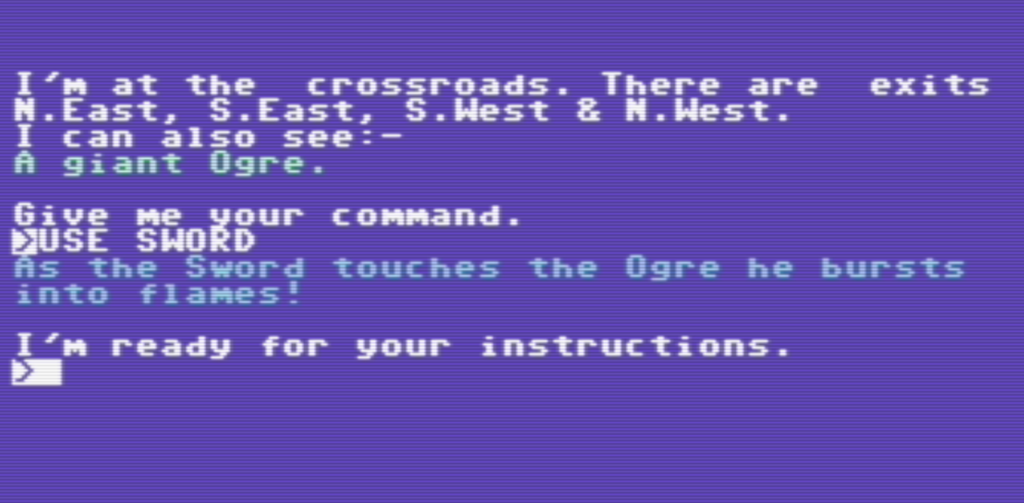
Continuing like this, we eventually get to a scroll with some writing on it. Trails are better than snares. As far as I can tell this is useless and slightly odd information. It means nothing and relates to nothing. I can only think it is a leftover item from a puzzle that didn’t make it in to the game. Back and forth, back and forth. Remember you should wear as many items as you can, especially the treasures, as you find them.
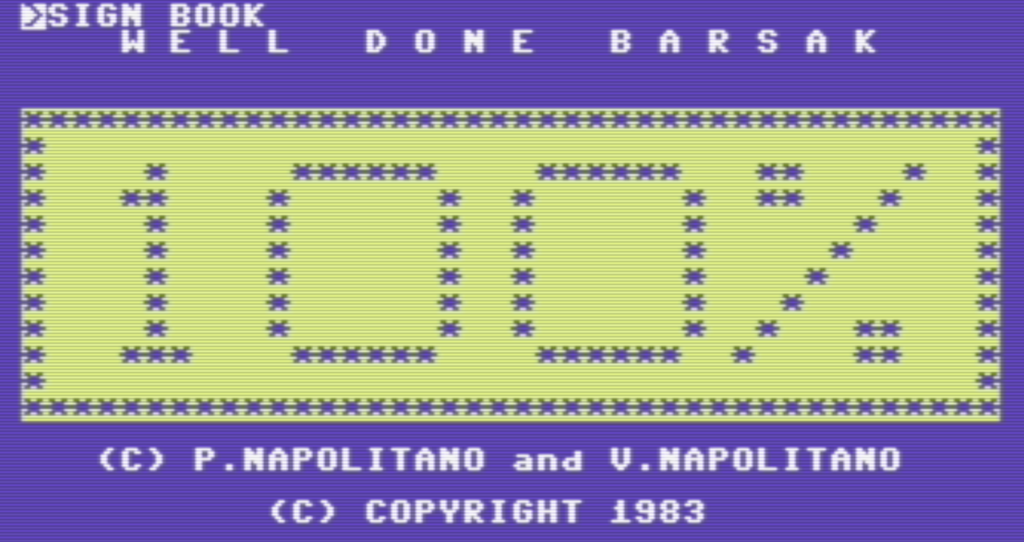
Eventually, after one of those annoying labyrinth sections where you just have to guess the exists and each location description is the same, you’ll get to an ante-room where, if you have all the treasures either on or about your person, a gateway appears. On entering this gateway you see a book which you need to sign and here’s another oddity and random move, you can’t sign the book with the lantern lit. I had to look that up as I don’t think I’d have ever thought of doing that.
If you think this review reads negatively about Barsak, well that’s because it annoyed me which I think is the exact opposite of what a game should do. It’s hard to strike a balance between playability and difficulty I know, but Barsak does not achieve this at all. Having said that, I admire the size of the game and number of locations. Having programmed games myself in The Quill I know how hard it can be, so hats off to the Napolitanos for creating this adventure. And it isn’t dreadful, really. It would have given younger me a lot of play time for the money, a lot of map making and a lot of lateral thinking which back then is what I loved more than anything else. A disk drive would have made it much more playable with quicker load times for the saves, and of course all modern C64 equivalents (Ultimate C64, VICE etc.) have disk drive capabilities built in.
I think on balance I would recommend playing this game, but be prepared for a long quest, a large notebook and meticulous organisation of your save files. If you are armed with all that information and still want to play Barsak, I think you’ll enjoy it.
A difficult and frustrating game at times, but ultimately rewarding with a long playtime and satisfying ending.